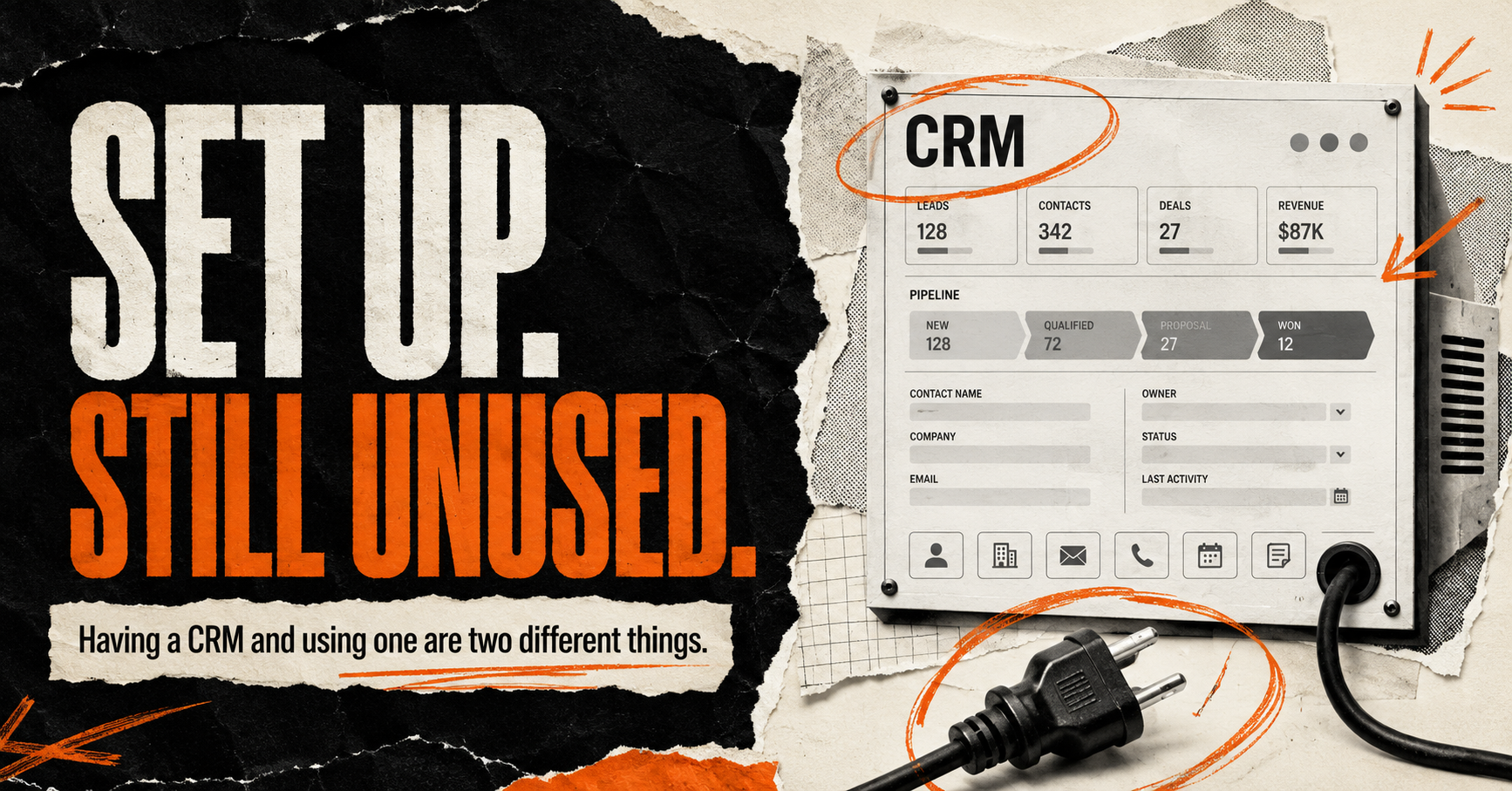
A CRM can be technically set up and still be completely useless.
The fields exist. The pipelines are built. The lifecycle stages are there. The dashboards look impressive. The forms are connected. The automation is technically running. Someone may have even spent months planning the implementation, migrating data, cleaning records, and training the team.
And yet, somehow, the business is still operating out of inboxes, spreadsheets, Slack messages, sticky notes, memory, and whatever one sales rep “swears they were going to update later.”
That is one of the most common CRM horror stories. The company bought the tool, configured the tool, announced the tool, and then never really changed how the team works. On paper, they have a CRM. In reality, they have an expensive database that everyone occasionally visits when they are forced to.
Having a CRM and using a CRM are two very different things.
A CRM Setup Is Not the Finish Line
A lot of companies treat the CRM launch like the end of the project.
They spend weeks or months getting everything ready, and once the system goes live, everyone acts like the hard part is over. The assumption is that because the CRM now exists, the team will naturally start using it.
That is not how it works.
A CRM implementation is not just a technical project. It is an operational change. It changes where information lives, how people communicate, how deals are tracked, how follow-up happens, how managers inspect the pipeline, how marketing measures lead quality, and how leadership understands the revenue process.
That means the real work begins after the CRM is launched. The system has to become part of the daily rhythm of the business. If the CRM is not where people go to understand what is happening with leads, deals, customers, and follow-up, then the setup itself does not matter very much.
The tool may be live, but the process is not.
Why Teams Keep Doing Things the Old Way

It is easy to blame people for not using the CRM, but in most cases, the issue is more complicated than laziness.
People keep doing things the old way because the old way is familiar. It may be messy, inefficient, and impossible to scale, but it is known. A sales rep who has managed their pipeline from memory for years may not immediately see the value in updating every deal stage. A founder who is used to checking in over Slack may not naturally start looking at pipeline reports. A marketing team that has always measured form fills in one platform and handoffs in another may not instantly trust the CRM as the source of truth.
New habits also create a temporary productivity dip. Even when the new system is objectively better, it can feel slower at first because people have to think about what they are doing. They have to remember where things go, which fields matter, when to create a deal, how to log an activity, and what updates are expected.
That friction is real.
But avoiding that temporary discomfort usually creates a much bigger long-term problem. The team stays comfortable, the CRM stays incomplete, and the business continues making decisions from scattered information.
The Cost of a CRM Nobody Uses
An unused CRM is not just a wasted software expense.
The bigger cost is the operational confusion it creates.
When the team does not consistently use the CRM, nobody really knows what is happening. Deals exist in someone’s head. Follow-ups depend on memory. Lead sources are incomplete. Lifecycle stages are unreliable. Reports become questionable because the data behind them is inconsistent. Marketing cannot tell which leads became revenue. Sales managers cannot trust the pipeline. Leadership cannot see where opportunities are getting stuck.
This is how companies end up with two versions of reality.
There is the reality inside the CRM, where the reports say one thing. Then there is the reality inside the team, where everyone knows the CRM is missing half the story.
That is a dangerous place to operate from because the company starts making decisions based on data that everyone quietly knows is incomplete. Forecasts are unreliable. Attribution is fuzzy. Sales performance is harder to coach. Marketing campaigns are harder to evaluate. Customer handoffs are more likely to break.
The CRM was supposed to create clarity. Instead, it becomes another place where the mess lives.
Adoption Is a Leadership Problem, Not Just a Training Problem
When teams do not use the CRM, the first instinct is usually to schedule more training.
Training can help, but training alone rarely fixes adoption. Most people do not ignore the CRM because they have never seen a walkthrough of how to click the buttons. They ignore it because the business has not made the CRM central to how work actually happens.
If leadership still asks for pipeline updates in a meeting instead of looking at the CRM, the team learns that the CRM is optional. If managers accept “I’ll update it later” as normal, the team learns that stale data is tolerated. If important decisions are still being made from side spreadsheets, the team learns that the CRM is not really the source of truth.
People pay attention to what the business rewards, inspects, and depends on.
If leadership wants the CRM to matter, leadership has to use it as if it matters. Pipeline reviews should happen from the CRM. Lead follow-up should be measured in the CRM. Sales activity should be tracked in the CRM. Marketing-to-sales handoff should be visible in the CRM. Customer context should live in the CRM.
The team will not treat the CRM like the source of truth if leadership treats it like a suggestion box.
The CRM Has to Be Easier Than the Workaround

One of the biggest reasons CRM adoption fails is that the official process is more annoying than the workaround.
If updating a deal requires too many fields, too many clicks, too many unclear decisions, or too much duplicate entry, people will find another way. They will use notes apps, spreadsheets, inbox folders, Slack threads, or their own memory. Not because those systems are better, but because they feel faster in the moment.
This is where companies have to be honest about the way the CRM is designed.
A good CRM process should capture the information the business actually needs without turning every update into paperwork. Required fields should be used carefully. Deal stages should be clear. Lifecycle stages should be defined. Notifications should matter. Views should be useful. Dashboards should answer real questions. Automation should reduce manual work instead of creating more confusion.
The goal is not to make the CRM perfect. The goal is to make the right behavior easier than the wrong behavior.
If the workaround is faster than the system, the workaround will win.
CRM Adoption Requires Clear Rules
A CRM cannot run on vibes.
If people are expected to use the system consistently, they need to know what “using the CRM” actually means. Otherwise, everyone invents their own version of the process.
When should a new contact be created? When should a deal be created? What qualifies as an opportunity? What does each pipeline stage mean? When should a lead move from Marketing Qualified Lead to Sales Qualified Lead? What needs to happen before a deal can move to proposal? Which fields are required, and why do they matter? What should be logged after a call? What happens when a lead goes cold?
These questions may sound basic, but they are exactly where messy CRM operations usually begin.
A lot of teams are told to “keep the CRM updated,” but they are not given clear standards for what that means. Then leadership gets frustrated when the data is inconsistent, even though the process was never clearly defined in the first place.
Good CRM adoption depends on simple, shared rules that everyone understands. The rules do not need to be overly complicated, but they do need to exist.
The CRM Should Support the Sales Process, Not Replace It
Buying a CRM does not automatically give a company a sales process.
This is where a lot of businesses get disappointed. They expect the CRM to create structure, but the CRM can only reflect and support the structure that exists. If the sales process is unclear offline, it will usually become unclear inside the CRM too.
A messy pipeline does not magically become clean because it is built in HubSpot, Salesforce, or any other platform. Undefined deal stages are still undefined. Inconsistent follow-up is still inconsistent. Poor qualification is still poor qualification. If nobody agrees on what the process should be, the CRM simply gives the confusion a nicer interface.
That does not mean the tool is useless. It means the tool has to be paired with operational thinking.
The CRM should help your team follow the process, document the process, improve the process, and measure the process. But it cannot compensate for a process that nobody has actually defined.
Start With the Moments That Matter Most
If a team is not using the CRM consistently, the answer is usually not to fix everything at once.
A better approach is to identify the most important moments in the customer journey and make sure those moments are captured correctly. Start with the points where missing information creates the most damage.
For many businesses, that means focusing on new lead capture, sales handoff, deal creation, stage progression, follow-up activity, proposal status, closed won, and closed lost. If those moments are tracked consistently, the company gains a much clearer picture of what is happening across the revenue process.
Once the core workflow is reliable, the business can add more sophistication. More automation, more reporting, more segmentation, more attribution, and more advanced processes are all easier to build when the foundation is actually being used.
The worst move is to overbuild a CRM that the team has not adopted yet. Complexity does not solve adoption. In many cases, it makes adoption worse.
A CRM Only Works When It Becomes the System

A CRM should not be a separate administrative chore that happens after the real work.
It should be part of the work.
When a lead comes in, the CRM should show who owns it and what happens next. When a sales conversation happens, the CRM should capture the important context. When a deal moves forward, the pipeline should reflect that movement. When a deal is lost, the reason should be recorded. When marketing wants to understand lead quality, the CRM should help answer that question. When leadership wants to understand revenue health, the CRM should be the place they look.
That is the difference between a CRM that exists and a CRM that operates.
The system only becomes valuable when the team trusts it, uses it, and depends on it. Until then, it is just another tool the company pays for while continuing to run the business the old way.
Final Thought
Having a CRM is not the same thing as having an operating system for your business.
A CRM that nobody uses will not fix your follow-up process, clean up your pipeline, improve your attribution, align marketing and sales, or give leadership better visibility. It will mostly sit there, slowly collecting stale data while everyone continues working around it.
The real value comes when the CRM becomes part of how the company actually runs.
That takes process. It takes leadership. It takes clear expectations. It takes some short-term discomfort while people build new habits. And it takes a system that is simple enough for the team to use consistently.
Because the goal is not to say you have a CRM.
The goal is to build a business where leads, deals, follow-up, and customer relationships are not scattered across everyone’s inboxes, memory, and side spreadsheets.
The CRM does not create clarity just by existing.
Your team has to use it.